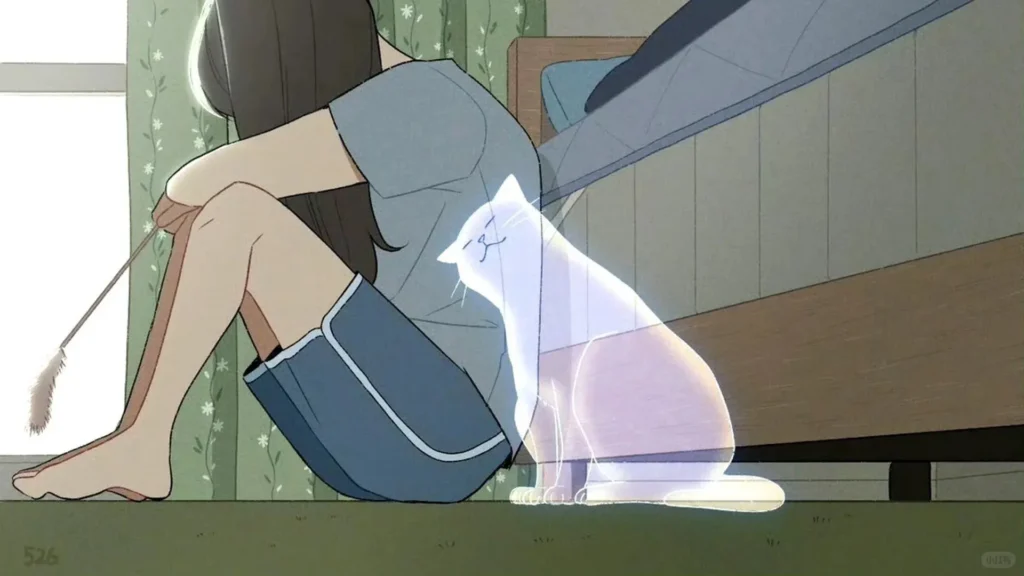
For a long time after Coffee passed away, I carried a quieter, more uncomfortable kind of grief.
I kept asking myself a question I didn’t dare say out loud:
Why does this hurt more than when my grandmother died?
I didn’t want to compare losses.
I didn’t want to sound ungrateful.
So I pushed the question away — until I couldn’t anymore.
It wasn’t until I spoke with a pet communicator, someone who had heard hundreds of similar stories, and until I allowed myself to look honestly at my own emotions, that the answer slowly became clear.
This grief isn’t deeper because we loved more.
It’s deeper because we loved differently.
A Pet Sees the Most Unfiltered Version of You
Love between humans is complicated.
It carries expectations, history, responsibility, unresolved tension — and sometimes disappointment. Even in close families, we perform roles. We explain ourselves. We edit parts of who we are.
With a pet, none of that exists.
In front of them, you never have to translate yourself.
They see you when you’re exhausted, messy, emotionally unguarded — the version of you that doesn’t function well in the outside world. And they accept it without question.
They don’t love your achievements, your titles, or the version of you that others expect.
They love the self that exists when all of that is stripped away — sometimes awkward, sometimes childish, always real.
So when they’re gone, something rare disappears with them:
the one relationship where you were fully seen, fully accepted, without condition.
Losing a pet often means losing a piece of your most honest self.
A Relationship Untouched by Cruelty or Misunderstanding
For many people, the bond with a pet is the only relationship in their life that has never been damaged by words.
You never argued.
They never said anything meant to wound you.
There were no misunderstandings that lingered for years.
No apologies that came too late.
It’s a love that remained intact — pure, uncomplicated, untested by human ego.
When a pet dies, we’re not only mourning them.
We’re mourning the loss of a connection with 100% emotional safety.
And the truth is, most of us will never experience that kind of emotional purity again.
The Regret That Has Nowhere to Go
When a human loved one passes away, grief is often surrounded by logistics: hospital decisions, paperwork, funerals, family responsibilities. As painful as those moments are, they create structure. They give grief somewhere to move.
Pet loss is different.
The regrets are smaller — and sharper:
“Was I rushing during our last walk?”
“Why didn’t I open that favorite treat sooner?”
“Could I have done better?”
These regrets feel too minor to bring into formal mourning spaces, yet too painful to ignore. So they turn inward, becoming self-blame that repeats endlessly.
That’s why grieving a pet can feel relentless.
There is no ceremony big enough to hold these quiet questions.
You Are Not Overreacting
If you’ve ever wondered why losing a pet hurts more than losing a family member, please know this:
You are not heartless.
You are not disrespectful.
You are not “too emotional.”
You are grieving:
a love that was never contaminated by expectation
a bond where you were fully accepted
a daily life that was gently, consistently filled with presence
Pets teach us the rarest form of love humans ever encounter — how to love without conditions, and how to be loved without earning it.
They do this in a short lifetime.
And when they leave, it hurts precisely because that lesson was so complete.
You didn’t lose too much.
You experienced something incredibly pure.
And in a quiet, painful way —
you’ve graduated.
More Ways to Remember Your Pet
 Also explore: Home | Pet Memorial Guide | Pet Loss Support